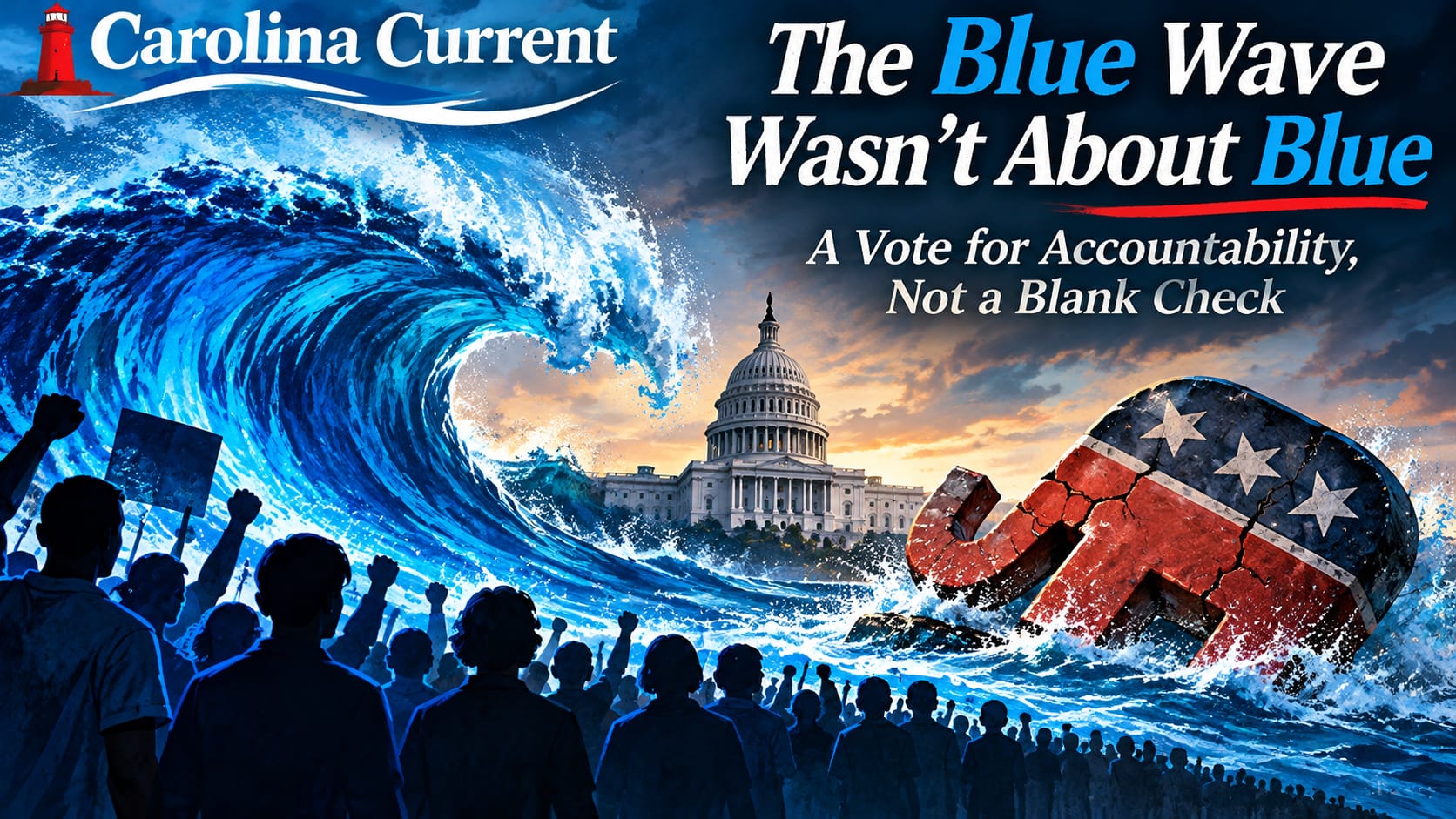
The Blue Wave Wasn’t About Blue
A Vote for Accountability, Not a Blank Check
By Craig Phillips | Carolina Current | Opinion | November 4, 2026
America voted Tuesday. And while the headlines are celebrating a Democratic blue wave, I believe the real story is something much bigger than a political party winning an election.
The American people reminded Washington who is supposed to be in charge.
Democrats captured control of both chambers of Congress in the November 3 midterm elections, overturning Republican majorities and delivering a significant political setback to President Donald Trump and his administration.
In North Carolina, former Governor Roy Cooper won a U.S. Senate seat, while Democrats also gained control of the state House of Representatives. Even here in the Cape Fear region, the political landscape shifted.
But I don’t see these results primarily as a celebration of the Democratic Party.
I see them as a rebuke of the Republican leadership that voters decided had failed them.
And more importantly, I see them as evidence that our democratic machinery, battered and mistrusted as it may be, can still work.
When Faith in the System Disappears
For nearly two years, I largely stopped following political news.
That’s a strange admission from someone who has spent much of his professional life working in media and journalism. But there comes a point when watching the daily political spectacle begins to feel less like staying informed and more like witnessing an endless performance in which accountability never arrives.
I had become deeply disillusioned with the Trump administration, the political institutions surrounding it, and what I perceived as an increasingly troubling disregard for meaningful oversight.
The outrage was constant. The consequences seemed nonexistent.
Eventually, I stopped watching.
Not because I stopped caring about this country. Quite the opposite. I cared enough that watching what I believed was happening to its institutions became profoundly discouraging.
I had nearly lost faith in the system itself.
Then came November 3.
For the first time in a long time, I felt something I hadn’t expected to feel again.
Hope.
Not blind optimism. Not the belief that everything has suddenly been fixed.
Simply the realization that Americans still possess the power to change the direction of their government.
And when enough people exercise that power, the results can be extraordinary.
The Real Divide Isn’t Red and Blue
I’ve never believed that America’s fundamental political division is between Republicans and Democrats.
To me, the more consequential divide has always been between those who possess extraordinary power and wealth and those who must live with the decisions made by the powerful.
It’s not simply left versus right.
It’s also top versus bottom.
The wealthy and politically connected occupy a very different America from the people trying to pay rent, buy groceries, afford healthcare, raise children, or survive on a paycheck that doesn’t stretch nearly far enough.
Those pressures don’t disappear because someone registers as a Republican or a Democrat.
A conservative family struggling to afford housing and a liberal family facing the same problem have far more in common than political rhetoric might suggest.
Their children attend schools. Their parents grow old. Their medical bills arrive. Their grocery prices rise.
They worry about tomorrow.
And yet we spend an astonishing amount of time being encouraged to see one another as enemies.
We argue over political identities while enormous concentrations of economic and political influence remain largely beyond the reach of ordinary citizens.
This doesn’t mean every wealthy person is an adversary or that every political disagreement is manufactured. Genuine differences over policy, values, and the role of government exist.
But those differences should not prevent us from recognizing our shared interests.
We are, for the most part, navigating the same economic system, facing many of the same pressures, and depending on the same democratic institutions.
We should be demanding that those institutions work for all of us.
A Rebuke Is Not an Endorsement
One of the biggest mistakes Democrats could make following this election would be to interpret every vote in their favor as an enthusiastic endorsement of their party.
That would be a dangerous assumption.
The results demonstrate a substantial shift in political power. They do not, by themselves, establish precisely why every voter made a particular choice.
Some voters undoubtedly supported Democratic candidates and their policies. Others may have been motivated primarily by dissatisfaction with Republican leadership, the cost of living, or concerns about the direction of the country.
Those distinctions matter.
A political party can win an election without winning the lasting trust of the electorate.
And that trust must be earned.
If Democrats interpret this election as permission to return to business as usual, they risk missing its most important lesson.
Public office is not an entitlement.
Political power is borrowed from the people, and the people can take it back.
What This Means for North Carolina
Here in North Carolina, the election carries particular significance.
Roy Cooper’s victory in the U.S. Senate race and the change in control of the state House signal a shift in the balance of political power.
For communities throughout Wilmington, Carolina Beach, and the greater Cape Fear region, the questions now become practical ones.
Will elected officials address the rising cost of housing?
Will infrastructure keep pace with growth?
Will public schools, healthcare facilities, and essential services receive the attention they need?
Will government become more transparent and responsive to the people it serves?
These are not exclusively Democratic or Republican concerns.
They’re community concerns.
And they’re the kinds of questions Carolina Current will continue asking, regardless of which party holds office.
Accountability Begins Now
An election victory is not the same thing as meaningful change.
The newly elected Congress will face the responsibility of governing, conducting oversight, and deciding how to use its constitutional authority.
There will be investigations, legislative battles, disagreements, and difficult decisions.
There should be scrutiny.
There should be transparency.
And where credible evidence establishes wrongdoing, there should be consequences through lawful and appropriate processes.
But accountability cannot become merely another partisan weapon. The same standards must apply regardless of which political party holds power.
Otherwise, we haven’t repaired anything. We’ve simply changed who gets to operate the machinery.
The American people deserve better than that.
Something Worth Believing In Again
I don’t expect everyone reading this to share my political opinions.
That’s not the point.
You may be a lifelong Republican, a committed Democrat, an independent, or someone who has become thoroughly disgusted with both parties.
I understand that last group particularly well.
But I hope we can agree on something fundamental.
Our government belongs to us.
Not to a president. Not to a political party. Not to billionaires, corporate interests, or the people who finance election campaigns.
To us.
And while our political system has serious flaws, elections remain one of the most important mechanisms through which ordinary Americans can demand change.
November 3 reminded me of that.
For nearly two years, I had watched my confidence in American political institutions fade.
Today, some of that confidence has returned.
Not because the Democrats won.
But because the people demonstrated that those holding power can still be held accountable.
The blue wave may have changed the balance of power in Washington.
What matters now is whether it changes anything for the people who live outside it.
The election is over. The accountability is just beginning.
Craig Phillips is a journalist and commentator with Carolina Current, covering Wilmington, the Cape Fear region, and issues affecting communities across North Carolina. Opinions expressed in this column are his own.
Sources for election results:
Associated Press — November 3–4, 2026
https://apnews.com/article/ef6199e25927a9ac9f4c18eae0e497cd
Reuters — November 4, 2026
https://www.reuters.com/business/media-telecom/takeaways-us-midterm-elections-2026-11-04/
WUNC — North Carolina Election Coverage
https://www.wunc.org/live-updates/midterms-2026-liveblog-cooper-whatley-election-voting