
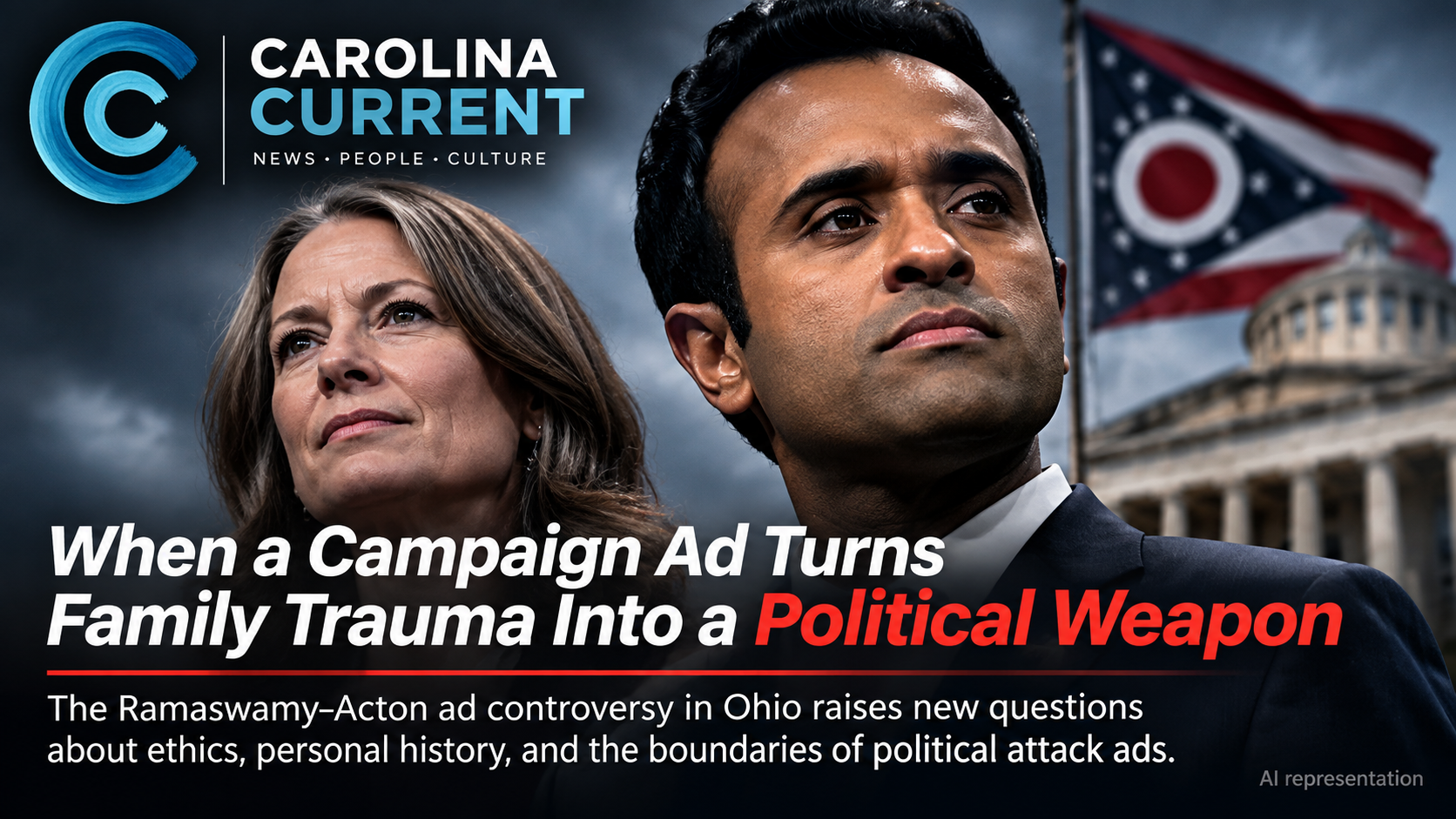
When a Campaign Ad Turns Family Trauma Into a Political Weapon
Carolina Current | News & Analysis
Political advertising has never been particularly gentle. Candidates question each other’s judgment, challenge their records and sometimes stretch an argument until it barely resembles the truth. But a commercial in Ohio’s 2026 governor’s race raised a different question: What happens when a campaign turns a candidate’s painful childhood into a test of political credibility?
An unusual messenger
Republican gubernatorial candidate Vivek Ramaswamy’s campaign produced an advertisement featuring Donna Arthur, the estranged mother of Democratic candidate Dr. Amy Acton. Arthur challenged her daughter’s honesty. That would be a striking intervention in any campaign, but the family history made it especially fraught.
Acton has publicly described being sexually abused by her stepfather as a child. She and her brother were removed from their mother’s custody after the stepfather was indicted on a rape charge. The relationship between Acton and her mother had been broken for decades. Those facts are essential context for understanding why the advertisement drew such intense criticism.
A controversy that crossed party lines
The campaign defended the advertisement as an attempt to raise questions about Acton’s truthfulness. Acton and her brother pushed back. Ohio Governor Mike DeWine, a Republican who had endorsed Ramaswamy, called for the ad to be pulled. President Donald Trump and Vice President JD Vance defended the campaign’s decision. The commercial later stopped airing.
The split is instructive. Even among political allies, there was no agreement that the advertisement represented a fair way to examine a candidate’s fitness for office.
What should voters be evaluating?
There are serious questions to ask of anyone seeking to govern a state: How would they manage public health? What is their plan for schools, jobs, housing and the budget? How do they respond to crises, and can they earn public trust?
A candidate’s personal history can sometimes illuminate character or judgment. But an accusation from an estranged family member is not self-validating evidence. And a survivor’s account of childhood abuse demands care, not the shorthand of a thirty-second political spot.
That distinction matters beyond Ohio. Voters in North Carolina and across the country encounter increasingly aggressive campaign messages, often through clips stripped of the context needed to assess them. The useful question is not merely whether an ad is effective. It is whether its central claim is relevant, substantiated and fair.
The line campaigns choose to draw
Campaigns make deliberate choices about which stories to tell. Those decisions reveal something about the political culture they are willing to encourage. The Ohio controversy is a reminder that a legal or attention-grabbing message can still fail a basic test of judgment.
As the next wave of elections approaches, audiences would do well to examine not just what political ads say, but what they leave out—and whose pain they ask the public to turn into a verdict.
Further reporting
Background reporting: Associated Press; CBS News; Axios.